MoreExam
1. Question Content...
EXPLANATION
Answer: X - EXPLANATION Content.
Question1: Which two storage technologies can an administrator use to deploy the Virtual Machine File System (VMFS)? (Choose two.)
Question2: When deploying a vCenter Server Appliance, which two single sign-on (SSO)-related options are presented to an administrator? (Choose two.)
Question3: An administrator is asked to take a snapshot of a virtual machine prior to an application upgrade. The virtual machine has one standard virtual machine disk (VMDK) and one physical mode raw device mapping (RDM) attached.Which statement is true with regard to taking this snapshot?
Question4: Which two VMware features are supported in a virtual machine using Intel Software Guard Extensions (Intel SGX) technology? (Choose two.)
Question5: Which step can an administrator take so that vSphere can access patch information if vCenter Server does NOT have Internet access?
Question6: A virtual machine with a single 100 GB virtual machine disk file has a single 20 GB snapshot. The virtual machine is powered off.How much additional free space on the datastore is required to delete the snapshot, committing the snapshot delta disk to the base disk?
Question7: An administrator can attach a baseline to which two inventory objects? (Choose two.)
Question8: Which resource pool setting is used to specify the relative priority or importance as high, normal or low?
Question9: vCenter High Availability (HA) protects vCenter Server against host and hardware failures. What is the minimum number of ESXi hosts required to enable this capability?
Question10: What is the minimum CPU core requirement for successful installation, or upgrade, of ESXi on a host?
Question11: Which privilege is required to run the esxtop utility?
Question12: There are two vSphere clusters in a company environment. One cluster is hosting development workloads and another is hosting production workloads. Both vSphere clusters are managed by the same vCenter Server. The application team would like to move a new virtual machine from the development to production cluster with no downtime.Which feature would allow non-disruptive movement between these two clusters?
Question13: An administrator is trying to configure vCenter Single Sign-On from the vSphere Client but does NOT have permission. Which role is required in order to configure vCenter Single Sign-On?
Question14: A single host is manually configured to company standards.Which option would an administrator select to capture this configuration for future use?
Question15: An administrator is tasked with upgrading an existing VMware vSphere 6.5 environment to version 7.0. There are existing VMFS3 and VMFS5 datastores in the environment.Which two statements are true regarding this upgrade? (Choose two.)
Question16: An administrator wants to implement virtual machine encryption. Which component encrypts the virtual machine files?
Question17: Which step is required when adding an existing hard disk that is configured as a boot disk during virtual machine creation?
Question18: In a vSphere High Availability (vSphere HA) cluster, which condition can be detected by datastore heartbeating?
Question19: A new vSphere 7.0 environment is deployed with the following:* A single vCenter Server* Two vSAN clusters* A vSAN default storage policyWhich statement is true regarding virtual disk availability in this environment?
Question20: Which feature is a pre-requisite for configuring admission control on a cluster?
Question21: What can an administrator use to partition limited CPU and memory resources between two departments?
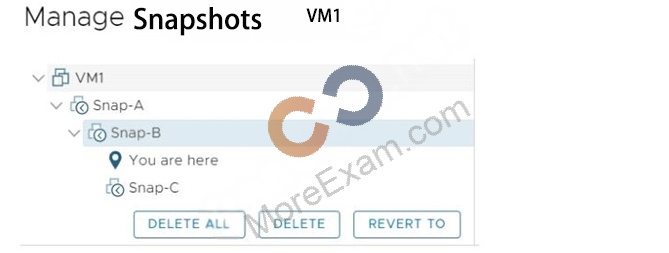
Question22: Refer to the exhibit.Which two statements are true regarding the state of the virtual machine (VM) if an administrator clicks the "Delete AH" option? (Choose two.)
Question23: An administrator is tasked with upgrading an existing vSphere environment to version 7.0. There are existing VMFS3 and VMFS5 datastores in the environment.Which statement is true regarding this upgrade?
Question24: An administrator needs to configure Proactive High Availability (HA) in a vSphere environment so that virtual machines (VMs) do not run on any partially degraded hosts. The administrator would also like to see the recommendations before VMs are migrated.Which automation and remediation level should the administrator select?